
Imagine you have a total sweet tooth. You walk into a bakery because you really want carrot cake, and the only thing on the display is a pile of raw carrots. You'd be like, okay, I wanted carrots, but not like that.
Here's the interesting thing. It's the same core ingredient. Somebody took that raw carrot and baked it into something people actually crave. They gave it a name, they put it in the cake, and they priced it like a dessert.
If you're trying to figure out how to find your niche, your expertise is that raw carrot. It's 15 or 20 years of judgment, pattern recognition, and lessons you paid for the hard way. Raw and unpackaged, nobody lines up for it, no matter how good it is. Baked into a specific offer for a specific buyer, people look for it by name.
Not sure which slice of your background is the most sellable part? I built a free tool for exactly that. The Offer GPT is a short series of questions that points you to the lane your years of experience have already built for you.
Why being good at everything is hard to sell
I can honestly say this because I spent my first few years building my online business as the raw carrot. Somebody would tell me what their problem was, and I'd go get it done for them. I had solved a large variety of problems over the course of my career, and it was difficult for me to pull out the best part so I could market it. So I'd say yes to the one task, and miss the big picture strategy I actually wanted to be working on.
Every single week I get some version of this in my Instagram or LinkedIn DMs: "Hey Laura, I'm a generalist. It's hard for me to figure out what my offer should be." I don't doubt that you're unique. But when you become known for everything, you accidentally become a master of nothing.
One of our students described two decades across banking, technology, and operations. She could run a merger integration, fix a broken operations function, and manage a leadership team through a crisis. Her conclusion from all of that range was that she had nothing specific enough to sell.
The truth is, 99% of mid-career professionals feel like generalists, because that's how careers work. Companies typically don't hire you for just a job title. If you're really good at your work, you end up going wherever the fire is. Your range gets broader, and you become the person who can see the whole picture: the ops, the marketing, the people, and the numbers together. That's exactly who a $10 or $20 million founder wants advising them.
The challenge is that when you try to describe that entire range to the market, nobody buys it. When you're not known for something specific, you become the person who does whatever is asked. You become overhead, easy to replace, and easy to negotiate down.
Nobody pays a premium for a task. They pay a premium for a specific outcome that nobody else in their company knows how to solve.
Lead with a painkiller offer
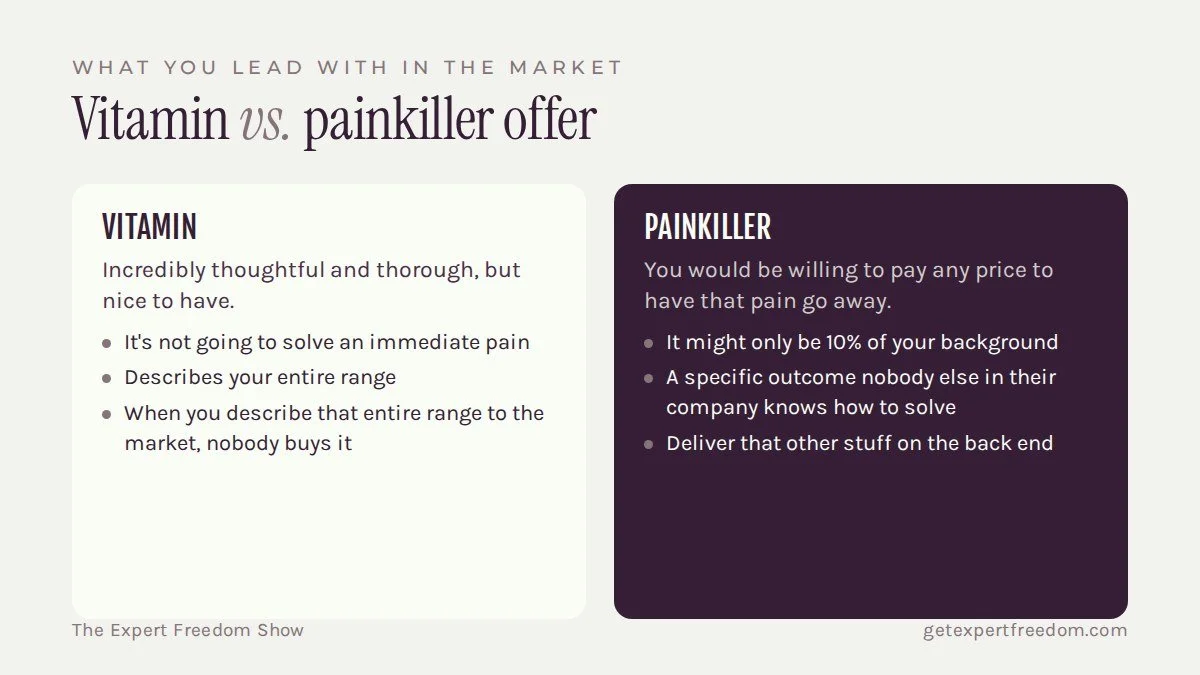
Here's the miscalculation I see over and over again. What gets sold in a conversation is often what I call a vitamin, but what the client actually wants and needs is a painkiller.
Think about the vitamins sitting in your kitchen. If they stay in the cabinet till tomorrow, you'll be just fine. They're nice to have, and they won't solve an immediate pain.
Now picture yourself out on a sports field, and you pull a muscle. You need an Advil or a Tylenol right away. If you're in an airport and that painkiller costs 2 or 3 times as much as it usually does, you'll buy it anyway. You'd pay any price to make that pain go away.
So many smart experts accidentally lead with a vitamin: incredibly thoughtful, thorough, and nice to have. Lead in the market with a painkiller offer instead, even if it's only 10% of your background. You can always deliver the other stuff on the back end. You don't have to abandon it forever. It just isn't the thing you become known for.
Here's where to start. Write down the last three things you got complimented for, by a boss, or by a former client if you're already running a business. Look for the one that made you think, that is a real problem in the market. That becomes your painkiller offer.
How I found mine
Early on, I was delivering all sorts of different offers to clients. I had an extensive background in marketing, sales, and branding: brand strategy, full-day brand positioning workshops, go-to-market playbooks, sales process work. I really prided myself on all of it.
As I kept growing in revenue and in clients, it became less and less sustainable. So I asked myself what my clients kept asking for again and again, and what created the biggest, most measurable result. It was sales process optimization. Many of my clients had existing leads, and I helped them make more money with those leads without adding team members or increasing their advertising spend. That's what I became known for.
And it's never boring. I solve that one problem for nonprofit organizations that need to increase enrollment in their programs and for for-profit companies that need to do more with their leads. For most of them it's maybe a few hours a week at the most, because everything is so systemized in the background.
Your range is still the product, and you'll use it when you go deeper with a client. What you lead with needs to make people really clear on the problem you solve, who benefits, and the result they'll get. That one sentence makes all the difference.
Five obstacles that show up when you build your offer
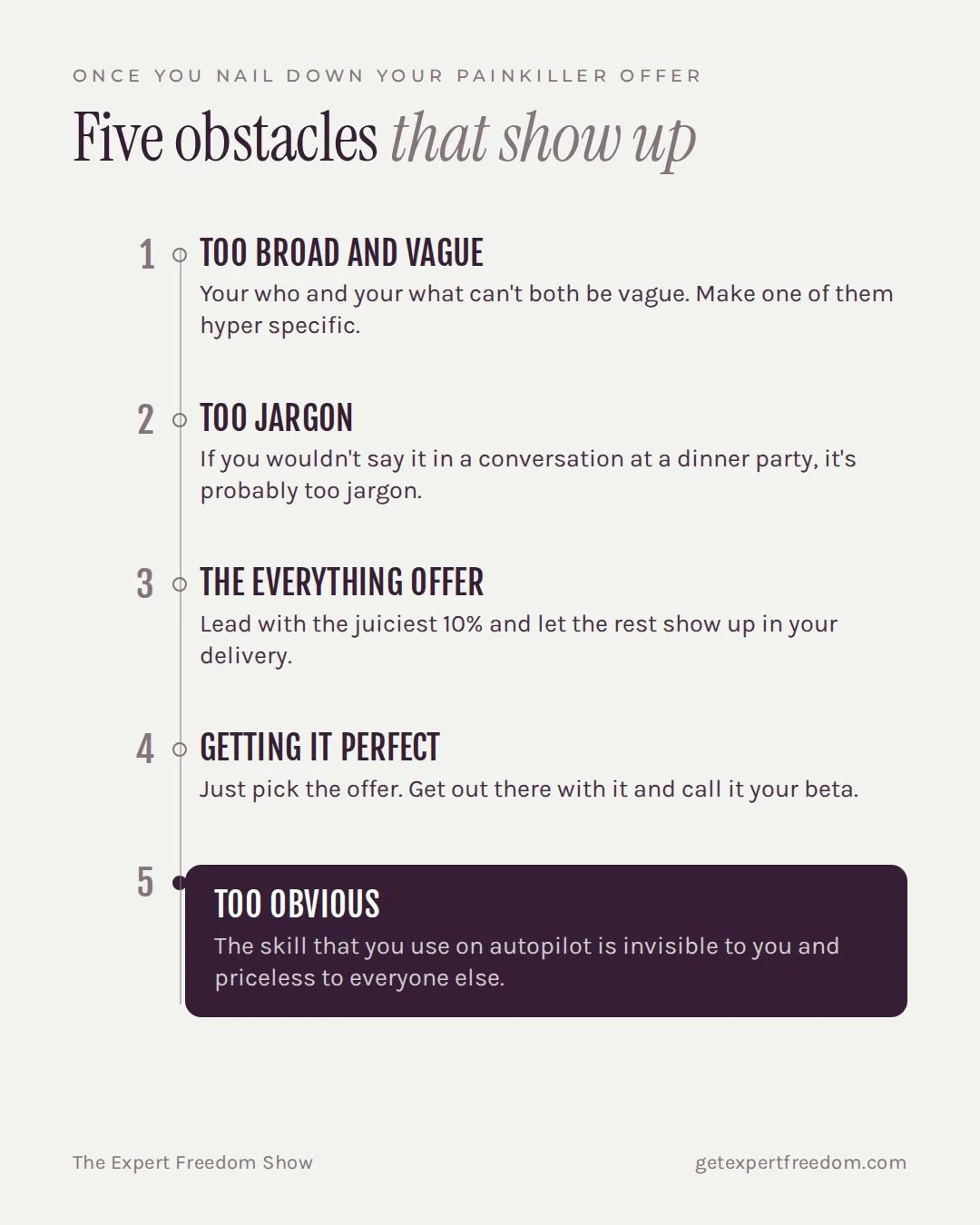
Once you nail down your painkiller offer, a few obstacles tend to show up as you actually build it. Here's how to get past each one.
1. The offer is too broad and vague
"I just help business owners grow." "I help leaders feel better about their management skills." That hands the client homework, and clients typically won't do their homework.
This comes down to your who and your what, which is something I teach inside Expert Freedom. They can be whatever you want them to be, but they can't both be vague. If you have a specific who, your what can be somewhat general, and the other way around. If both are specific, your total addressable market may be too small, especially when you're first starting out. If both are vague, you typically don't have a painkiller offer.
2. The offer is too jargon
"Operational excellence transformation" might be a slide title at your old company, or something that would fly in a presentation. It was never an offer. And if you got it from AI, it's probably too jargon.
Confused people tune out or simply say no. If you wouldn't say it in a conversation at a dinner party, it's probably too jargon.
3. The everything offer
This is a telltale sign of a vitamin. You want the offer to hold everything you know how to do from all of your 15 or 20 or 25 years, because leaving anything out feels like such a waste.
You'll tap into those skills when you deliver for the client. Lead with the juiciest 10% instead, and let the rest show up in your delivery. The result is an offer that opens the door to the sales conversation without having to hold everything you know.
4. Waiting until it's perfect
A lot of people feel they need to say it perfectly, or no one will hire them. I promise you, your enthusiasm and your excitement about your offer is what's going to sell it. The perfect sentence said in a monotone is so much less impactful.
So just pick the offer. Don't rehearse it 100 times. Get out there with it and call it your beta.
5. It feels too obvious
This one is surprisingly common, and it's the curse of expertise. The skill you use on autopilot is invisible to you and priceless to everyone else. You think to yourself, nobody's going to hire me for that, it's way too simple.
A lot of that comes from our conditioning that things need to be hard for us to earn our place. When our students first start working with clients, they're often shocked by how simple the prescription is, and by how much they need to dial back what they know to get on the same page with the client.
If you have 15, 20, or 25 years of experience and you genuinely can't see which slice to lead with, start with my free Offer GPT. It asks you a short series of questions and points you to the lane your background fits best.
How to find your niche: get your reps in
Here's the trap that often shows up next: "I'm scared to reach out until I know exactly what I'm offering." So people do more research or ask friends and family for opinions, which only creates more confusion.
After watching hundreds of students go through this exact exercise, here's what I know.
Niche clarity comes from reps, not from research and planning.
Your first handful of conversations will teach you way more about your offer than months and months of journaling about it.
One of my students closed six out of six advisory clients from six discovery calls, all with people she already knew. Before she came to me, she didn't even know that being an advisor to other businesses was a thing. She was going down the course creator path, following what everybody else was saying. When she found my content, she realized her background was perfect for advisory services. She had 15 to 20 years of experience in both medicine and technology, so she combined the two, and now she helps early-stage med tech companies find product-market fit. It's a complete painkiller.
She could have packaged her offer a variety of ways. The right one comes down to what the market needs and wants, and what gets you excited as an expert. The right conversations validated it and turned it into a long-term offer.
For so many of our students, the offer they start out with isn't the one they use to scale. And it's usually not the person you think will hire you who ends up being your first or your best client. The sequence matters more than anything else: get your painkiller offer, then have the right conversations to validate it. That's so much more important than trying to do everything at once.
As Pitbull says, "Ask for money, get advice. Ask for advice, get paid twice." Asking potential clients for their opinion and feedback on your offer often turns into revenue.
Finding your niche starts with three conversations
If you take one thing from this, let it be this. The raw carrot sitting on the bakery shelf was never the problem. The packaging, and how you were positioning your offer, was what held you back.
You already have the expertise. That's the good news. What you've been missing is the name, the shape, and the sentence that turns it into something people love to say yes to.
So here's your homework. Ask three people who know your work well, "What would you call me in to fix in an emergency?" Their answer is the first draft of your painkiller offer.
I want you to use what you already have. It is enough. And it was always enough.
You don't need more time, a bigger audience, more research, or more followers to get started.
If this helped, the Offer GPT is the fastest way to find your one sentence. It's a short series of questions, and it's free. And if you're ready for step two, book a call with my team and we'll point you to the right next thing.
Frequently Asked Questions
How do I find my niche when I'm good at a lot of things?
Lead with a painkiller offer, even if it's only 10% of your background. Write down the last three things you got complimented for, by a boss or a former client, and look for the one that's a real problem in the market. You can still deliver the rest of your range on the back end.
What is the difference between a vitamin offer and a painkiller offer?
A vitamin is nice to have. It can be thoughtful and thorough, but it won't solve an immediate pain, so it can wait till tomorrow. A painkiller solves a pain someone wants gone right now, and they'll pay any price for it. Lead in the market with the painkiller, and deliver the vitamins on the back end.
Should my offer include everything I know how to do?
No. The everything offer is a telltale sign of a vitamin. Lead with the juiciest 10% of what you know and let the rest show up in your delivery. You'll still tap into all of those skills once you're working with the client. Your offer only has to open the door to the sales conversation.
How do I know if my offer is too vague?
Look at your who and your what. They can be whatever you want, but they can't both be vague. If your who is specific, your what can be more general, and the other way around. And if you wouldn't say it in a conversation at a dinner party, it's probably too jargon to sell.
Do I need total clarity on my niche before I reach out to anyone?
No. Niche clarity comes from reps, not from research and planning. Your first handful of conversations will teach you more about your offer than months of journaling about it. One of my students closed six out of six advisory clients from six discovery calls, all with people she already knew.

About Laura Meyer
Laura Meyer is the founder of Expert Freedom and host of The Expert Freedom Show. Over more than 20 years as an entrepreneur, she built and franchised a 12-location company, then started over at 40 and rebuilt to a multi-seven-figure business on part-time hours. Today she advises businesses, sits on company boards, and helps experienced professionals turn their expertise into businesses that fit their lives. She’s a mom of three and a self-described tennis addict.