
Starting Over at 40: How I Rebuilt a Business Around My Life
I was recently on the sideline of my son's baseball game, in my favorite rocking chair with a cold sparkling seltzer, watching him play. And I realized I didn't need to check Slack. I didn't have an email to answer or a call to sneak in from the parking lot.
That boring moment is the most impressive part of my business. I got here by starting over at 40, after walking away from a 12-location company, and this time I built a multi-seven-figure business on part-time hours.
Nobody posts about moments like this because they aren't Instagram-worthy. But for most of the women I work with, that quiet is exactly what they want: white space, and a sideline with nothing due. So here's my actual path, including the models I tried and walked away from, and the order I'd follow if I were starting again today.
Not sure what your expertise is worth outside the building? I built a free tool for exactly that. The Niche Finder asks a few questions and tells you where to lean in based on your background.
Starting over at 40: a street MBA and a blank page
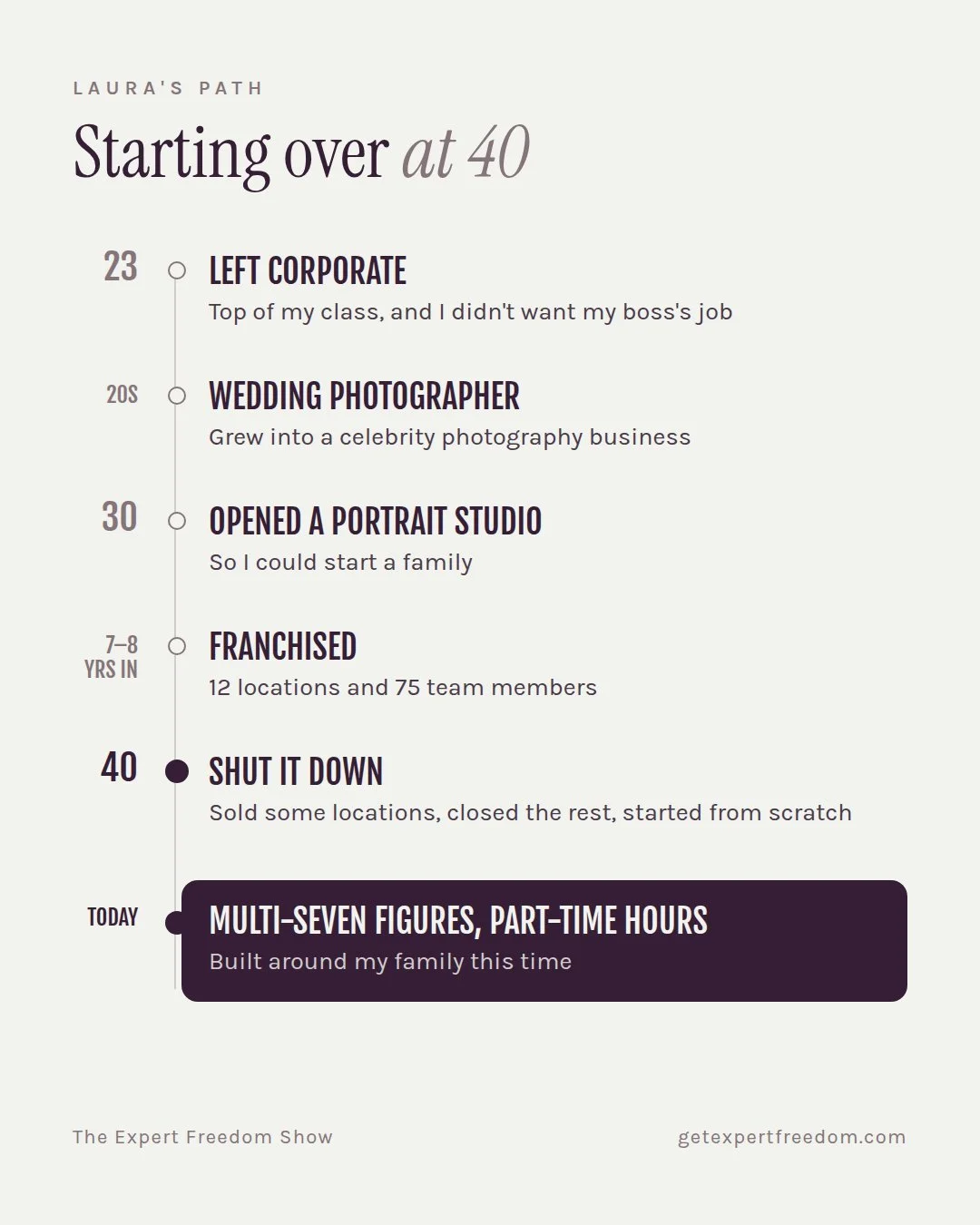
I didn't take a straight line. I graduated top of my class from business school, worked in corporate for a couple of years, and realized I didn't want my boss's job, or my boss's boss's job. At 23, with not much to lose, I left to become a full-time entrepreneur.
I photographed weddings all over the country and grew that into a well-known celebrity photography business, and I taught business to other photographers at conferences and workshops. At 30, I wanted to start a family, and being gone every weekend didn't fit. So I opened a children's portrait studio. Then a second location. Then people started asking to bring the concept to their area, and before I really knew what franchising was, I was franchising.
About seven or eight years in, we had 12 locations and 75 team members system-wide, with four more about to open. Then the industry shifted. Cell phone cameras lowered what customers thought photography was worth, and more competitors kept coming in. Right as I turned 40, I decided to shut it all down. We sold some locations, closed others, and I started from scratch.
I always joke that I did a lot of dumb things to become this smart.
It felt like grief. That business was my first baby and a huge part of my identity. When I came out the other side, I made myself one promise: no matter what I built next, I would never make that kind of personal sacrifice again. I've never wavered on it.
The three "lifestyle business" models that never fit my life
"Lifestyle business" is a trending phrase right now, and I've accidentally followed a lot of the people promising one. Almost all of them fit into one of three categories (which is kind of hilarious once you see it).
The bro-culture lifestyle programs. They look the part, hoodie on, hanging out in the wilderness. Then you dig in and they're working 12 hours a day, often with no family and few other responsibilities. They grind, eat dinner with their bros, hit the gym, and start over the next morning.
The girl-boss hustle programs. They talk about flexibility and freedom. Then you notice they've traveled four weeks in a row, or they tell you to post three, four, five times a day to grow.
The influencer lifestyle businesses. A content creator is always on. You document every part of your life, your kids, your home, your evenings with friends, because your life is the product.
As a woman with three kids and a really full life, none of those were ever an option for me. I started my business so I could have freedom, and I wasn't willing to abandon my family or give up my hobbies to build it.
If you've felt that same push and pull, here's the reassuring part. The online business world was never designed for someone like you, someone with real responsibilities who doesn't want every minute documented. You can still build a business there. You just have to build it on purpose, with freedom designed in from the start.
What I built the second time: high-ticket consulting first
When I started over online, I didn't have capital (I'd taken a real loss closing the business), and I had zero interest in another business that required so much of me. So I sold my knowledge and expertise to people I already knew. Before long I had a handful of consulting clients: fractional CMO work, private equity, and eventually nonprofit clients I never saw coming.
At the same time, I built courses, programs, and memberships, because that's what everyone said to do. They got some traction and then fizzled out. The consulting kept paying the bills.
For a long time I treated the consulting as the side thing. The cool kids were doing courses and low-ticket products, so I figured I'd sell advisory services until the "real" business took off. Then I did the math.
To replace a corporate income with low-ticket products, you need a huge number of people looking at your content and your landing pages every single week. That takes a tremendous amount of time and effort. It's a grind, and it is absolutely not passive income.
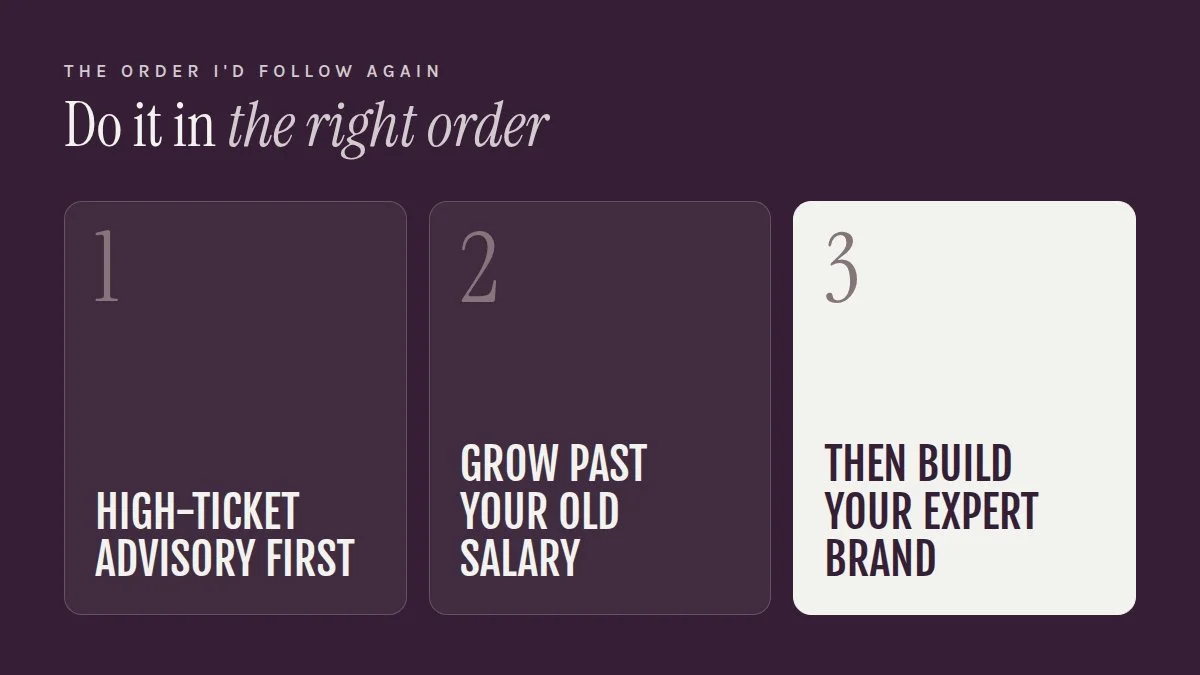
Selling high-ticket services to people who knew and trusted me was the goal all along. I figured out what they needed and solved their most pressing problems. That's the order I teach now:
Get to your first six figures, or multi-six figures, with high-ticket, low-volume advisory services. You don't need a huge following to replace a corporate salary this way.
Grow well past your old salary. All the personal, uncomfortable work of entrepreneurship is only worth it if you get a real return on it.
Then, if you want to, build your expert brand. Once your income feels secure, you can reinvest in audience growth and decide what you want to be known for, without the pressure of needing it to work today.
That last part matters more than people think. Your audience can feel desperation. The longer you can build an audience without needing people to buy from you, the stronger your expert brand will be in the long run.
Consulting, coaching, content
I do have a team now, but it came later. When I hit my first $200,000 to $300,000 a year, I reinvested a percentage of the profits into hiring. Every time the company grew, I hired someone to take something off my plate. A lot of people hire a big team too early and cut into the profit margins that make an online business so attractive in the first place.
Today I do three things. I consult, including a few board seats. I coach inside our community. And I create content. The team handles pretty much everything else.
If you're wondering which of your skills could become a high-ticket offer, start with the free Niche Finder. It takes a few minutes and gives you a clear place to begin.
Every yes has an invisible cost
It's easy to scroll your feed and decide success looks like what everyone else is doing. Post more. Get on stages. Partner with that early-stage founder for equity. When everything looks like a good opportunity, nothing gets edited out.
Most of those opportunities aren't good ones for you. Every time you say yes to something, you're saying no to something else, whether you realize it or not.
I learned this with YouTube. I started down that path because I saw real benefits, and some people do it beautifully. But getting discovered there meant filming B-roll constantly. I went downtown with a camera crew once and knew it wasn't for me. Then, on a family trip to Disney, with the sun out and everyone having a great time, I caught myself thinking I needed to grab some B-roll.
I didn't. We go to Disney every few years, so I only get a handful of those memories with my kids. The last thing I want them to remember is me messing with a tripod. That moment is a big part of why I moved from YouTube to podcasting.
Build the version that fits your life, even if nobody else's looks like it.
The inner work behind a freedom-first business
In my 20s and 30s, I never thought of mindset as part of being an entrepreneur. Restarting my business in my 40s changed that. Now I think it's everything.
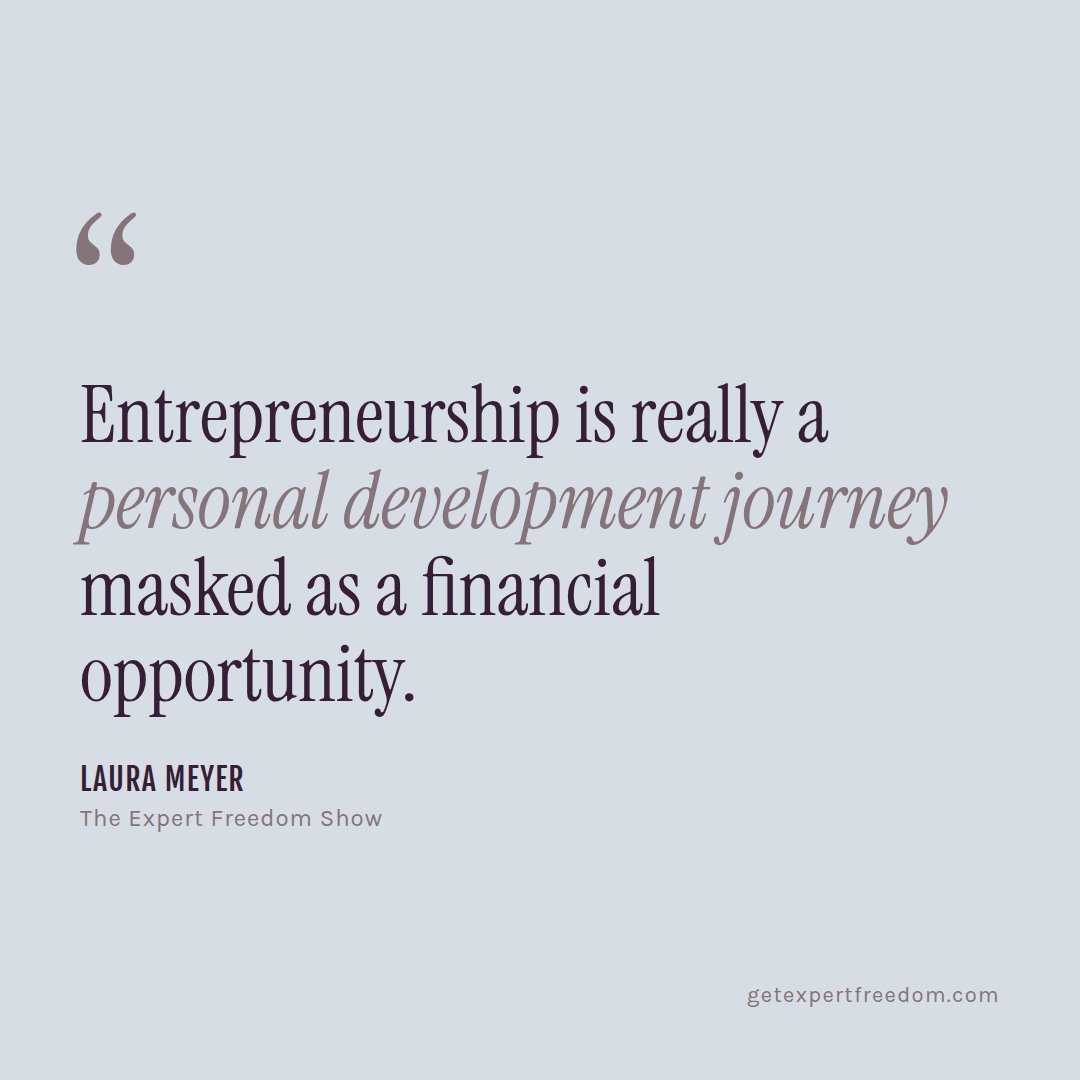
Entrepreneurship is really a personal development journey masked as a financial opportunity.
In corporate, other people decide a lot for you. In your own business, you have total control. That's the good news and the bad news, because every result you get is a mirror of your own thinking. I share my revenue numbers because people want to learn from someone who has been where they want to go. But the money is really a mile marker for the inner work, a measure of how much discomfort you're willing to take on to grow.
So here are the questions worth asking. Do I believe money is hard? Do I believe I'm worth making multi-six or seven figures without grinding and hustling for it?
A lot of us (I'm a Gen Xer) grew up with messages that we have to earn our worth as women, that we aren't allowed to take up space or say no, and that we need to keep everyone happy with us. Living that way takes a lot of over-functioning.
When you release it, you can build a business where your clients get amazing results without you doing the work for them or taking on their responsibilities. You can create tremendous value in just a few hours a day. Once you believe that for yourself, it starts to become possible.
Starting over at 40 (or 50) with what you already have
Everything I share is something I still do or have done to get here. I won't hand you advice I'm not living. On a Saturday I'm on a baseball sideline, cheering at a robotics competition, or in the middle of a tennis match, and I'm not checking Slack or getting back to a client from there.
If you're starting over at 40 or later and this resonated, it's probably because you already have years of experience. What you need is the right steps in the right order.
A good first step is figuring out where to lean in. Try the free Niche Finder and see where your background points you.

Hi, I’m Laura Meyer!
As a serial entrepreneur who has scaled multiple six and seven-figure online and offline companies over the last twenty years, I can genuinely say that consulting is the best industry I’ve ever been in.
Not only does it give me the freedom to spend time with my family and do the things I love (hello, tennis!), but working alongside world-changing entrepreneurs on their business strategies is one of the most rewarding roles I’ve had as an entrepreneur.
This is a blog where I share my secrets of how to become an in-demand consultant.