
How to Start a Consulting Business (Without Building an Audience First)
Every now and then, someone I play tennis with finds my social media account and stops me at the club. "Laura, do you work?" They had no idea. I do, and I've built my business on part-time hours the entire time, through three kids, a baby during COVID, and a school pickup line I'm in every single day.
So when people ask me how to start a consulting business, I start with what I'd skip. Most of what you see online says build an audience first: post every day, create a course, run ads, and hope something sticks. I've watched so many smart, experienced people burn through their time and savings that way. Time is your only non-renewable resource, so here's the path I'd follow instead, the same one I used to get to seven figures.
Already know you want help building this? Book a call with my team. They're graduates of the program, and they'll tell you honestly whether working with us is the right fit.
Start with your enough number
The enough number is a concept I learned from Morgan Housel's book The Psychology of Money, and it was a light bulb moment for me. It's the amount of money your household needs each month so you don't feel any scarcity. It has nothing to do with being rich or driving a Lambo. It's simply enough to feel secure.
Everyone's number is different. For me, it means I can hand someone my Amex when my kids want a private lesson, and give to charity whenever something pulls at my heartstrings. I also buy my clothes at TJ Maxx. Your number might look completely different, and that's fine.
Here's why this comes first. When you're in financial scarcity, it's really hard to make good decisions. People assume they have a mindset problem, and sometimes they do. More often, the business just doesn't have enough cash flow.
Cash is oxygen in a business, and it's hard to think straight when you don't have enough of it.
Without it, you feel like you have to book every client and keep every one no matter what. You end up selling from desperation, and people can feel it. So my core belief is simple. Grow your business to your enough number first. Skip the content stress, the course, and anything hypothetical. Once you're there, you get to decide what's next from a place of financial stability and mental space.
Make a leap to a new mountain
Most of us spend our careers climbing one mountain. Then we reach the top, or close to it, and realize it isn't what we want anymore. I lived this with my first business. I'd built a successful brick-and-mortar company, everyone wanted what I had, so I franchised it. It was the wrong path for me because what I wanted most, deep down, was freedom.
When people hit that point, a lot of them climb all the way back down and start from scratch, often with a passion or a hobby they've never been paid for. That path has two real challenges. Attention on a new topic is hard to turn into income, and your background may not put you in a position to win in that category yet.
What I recommend instead is a lateral move. Take your expertise, your experience, and the relationships you've built over 15 or 20 years, and carry them over to a new mountain. That's how I got to six figures in my first year of entrepreneurship and multi-six figures about 12 months in.
I understand wanting to leave your old work behind. After I closed my franchise, I wanted nothing to do with franchising. Once I'd healed, I realized that experience was my greatest asset, and today I serve on boards for franchises.
How to start a consulting business in three steps
You don't need a course, a following, or a fancy website. You need your expertise, the people who know and trust you, and some really good conversations.
Step 1: Identify the expertise you want to lean into
Ask yourself what problems you've solved again and again that other people struggle with. Then ask the more important question: what have you loved? This is about reaching your enough number in a way that's joyful for you.
Think about your favorite projects, and the emails from coworkers or your boss asking for help that you were most excited to get. It might be something that showed up on the side of your career. When I was running my brick-and-mortar business, I was always the person at cocktail parties off to the side brainstorming branding and marketing. I could have talked about it all day, so I eventually made it my offer.
Don't worry about credentials. Your experience is your degree. Every one of my star students who reached multi-six or seven figures wondered at the start whether they knew enough. After your first real conversation, you'll realize you know more than you thought.
Step 2: Land your first beta clients
Your first three clients should be slightly discounted. Say you plan to charge $5,000 a month. Your beta clients might come in at $3,000 or $4,000, and in exchange, you ask for a case study or testimonial if it goes well.
This takes the pressure off. You're not new to your expertise, but you are new to being a business owner. Be honest about it: "You're one of my first clients, so I'm discounting the service in exchange for a case study." They get a win, you get a win, and if you sleep on your advice and want to adjust it the next morning, it isn't weird. They know they're beta clients.
Step 3: Have real conversations
This one scares people, which is funny to me. I like to say I started in business while Zuckerberg was still filling out his Harvard application, so the only way to grow was to talk to people and build relationships.
Conversations create cash.
I see it in our program constantly. Someone hesitates to take a meeting, has the conversation anyway, and the person they asked for advice hires them. Posting to a few hundred followers won't get you clients at this stage. Relationships with people who know and trust you will.
Worry less about saying the perfect thing or being overly prepared. That's high-achiever, corporate conditioning. Worry more about caring about their company more than anyone else they've talked to. I call this the give-a-crap factor. Most people are out for themselves, so it isn't hard to stand out, and when you do, they hire you. I've had students land clients at $3,000 a month and at $20,000 a month. The model works at any price point because it's simple, and simple is what you need when you're starting.
Do the math: three clients, 15 hours a week
Let's say you land three clients at $4,000 a month. That's $12,000 a month in high-ticket recurring revenue. Each client might take three to five hours a week, so on the high end, you're delivering 15 hours a week. You don't need staff. You can run it with an AI executive assistant, which we hand our students inside Expert Freedom, so your costs are some software and maybe a cloud bill.
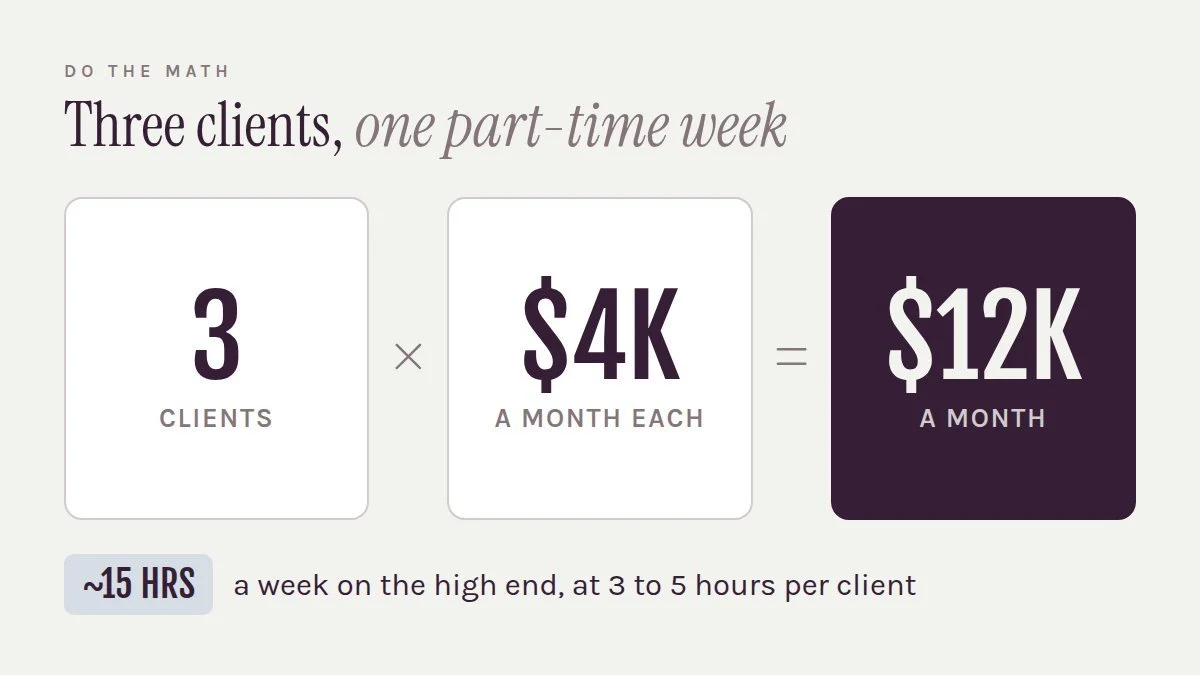
If you're wondering how anyone delivers an engagement in three to five hours a week, the difference between a 60-hour week and a 10-hour week is in the delivery. In the beginning, people say yes to you and it's so exciting that you give away everything. "Do you want everything in my house and my firstborn too? Here you go." Suddenly you're working 60 hours a week for three clients, with all the risk of entrepreneurship. That's another job with three bosses.
Clients want their problem solved for the long term, and they don't care how many hours it takes. If a prospect starts asking about your hours, your value got lost somewhere in the conversation.
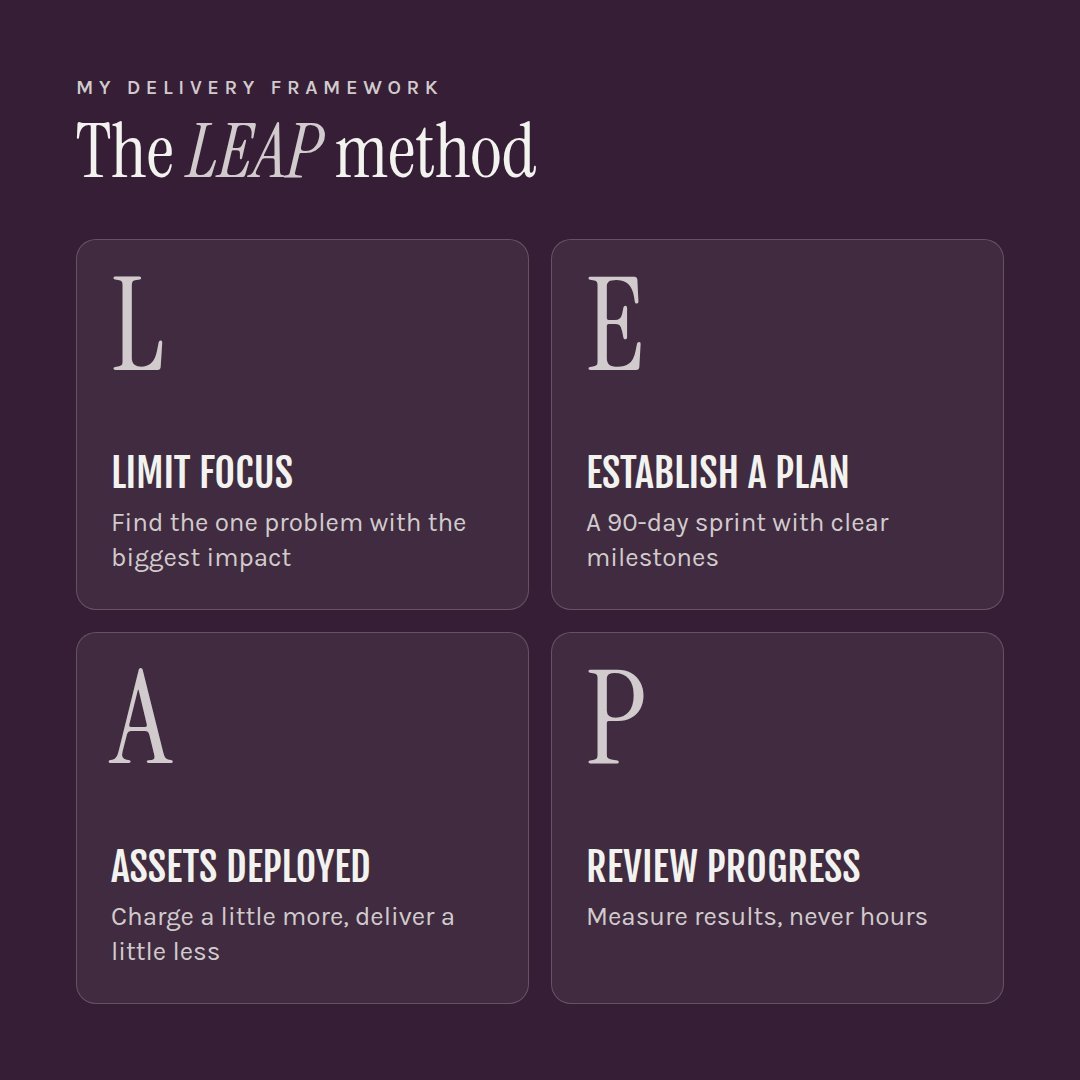
So I spent years perfecting a delivery system I call the LEAP method:
Limit focus. Find the one problem that will drive the biggest impact and shape the whole engagement around it.
Establish a plan. Build a 90-day sprint with clear milestones and deliverables, so everyone agrees on what success looks like from the start. Without that plan, you become a smart person they pay by the hour.
Assets deployed. This is where the advising happens. Over time you'll learn you don't need most of what you include, so with every client, charge a little more and deliver a little less.
Review progress. Measure the impact of your results, never your hours or effort. Gather testimonials, refine your offer, and watch one client become two, then three.
Today my own client delivery is an hour or two a week at most, and my clients get phenomenal results. Working fewer hours doesn't have to cost your clients anything.
If you'd like the full system behind these steps, including the scripts, pricing, LEAP method, and Beta Client Blueprint, book a call with my team. It'll bring you clarity on your best next step.
Your 30-day roadmap
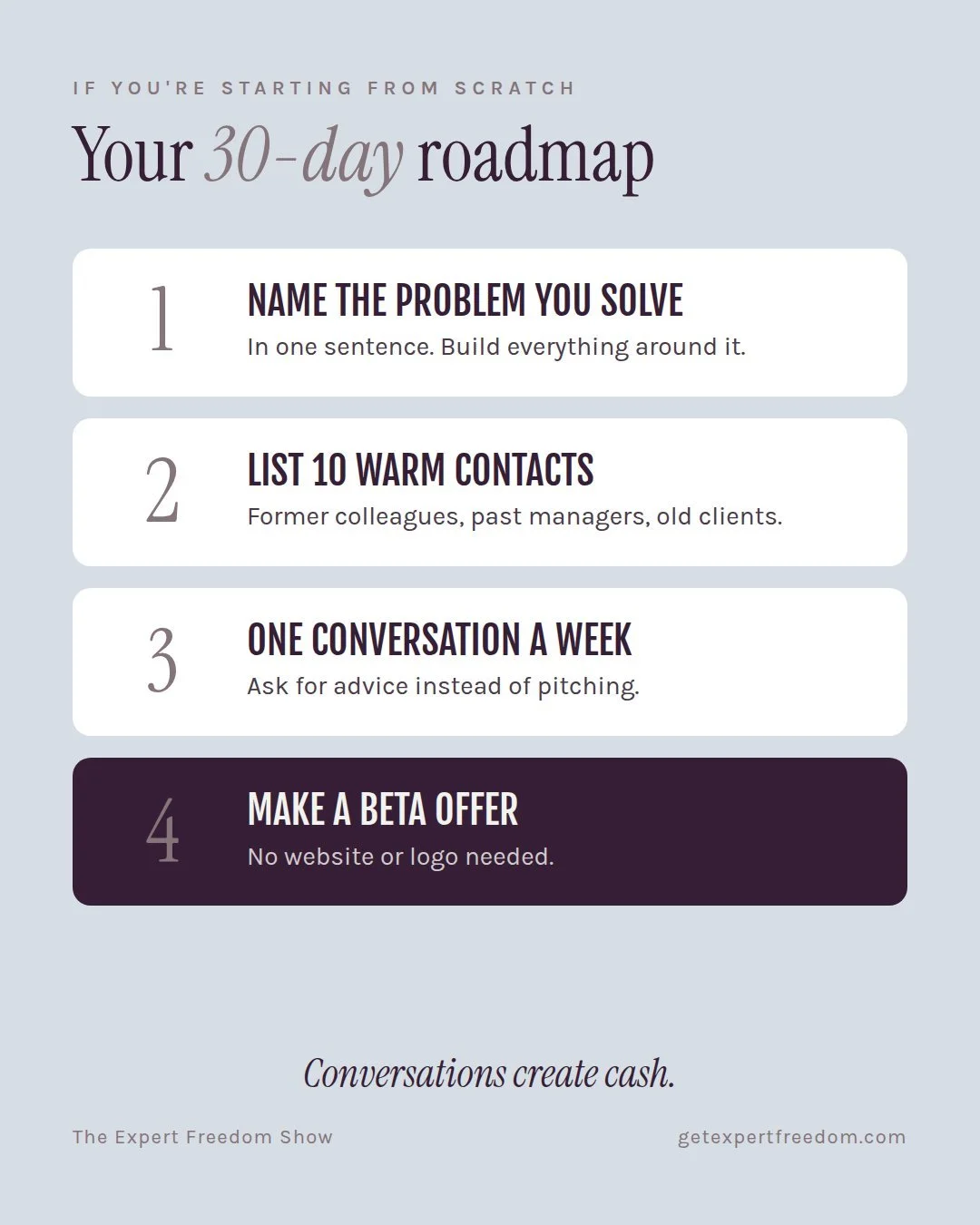
If you're starting from scratch, here's what to do this month:
Name the problem you solve in one sentence. Pick the problem you've solved repeatedly, that you'd happily talk about all the time, and that a business would pay to have fixed right now. Everything gets built around that sentence.
List 10 warm contacts. Former colleagues, past managers, old clients, businesses in your community you already frequent. Just write the names down. That's the whole step.
Have one conversation a week. Ask for 15 or 20 minutes and ask for advice instead of pitching. If you're an operations leader, you might ask, "What's the biggest challenge you're dealing with right now on the operations side?" Get genuinely curious. If you hear a problem you can solve, say so. They'll be thrilled.
Make a beta offer. You don't need a website or a logo. Say, "Here's how I can help you, here's what working together would look like, and here's what it costs."
The worst thing that can happen is a no, and your business can survive a no. It can survive hundreds of them. The more no's you hear, the more successful you'll be. Staying stuck is the thing you won't survive.
Start your consulting business in the right order
Once your advisory practice is paying your enough number, whether that's $10,000, $20,000, or $30,000 a month, seven figures comes in three stages:
The advisory practice. Everything above. That's your six figures.
An expert brand. Build an audience by positioning yourself as an expert and a thought partner, using client results and stories as your content. You can take your time because your practice pays the bills.
A group program. Once you have an audience, one-to-many delivery takes you to seven figures.
That's how I did it. About four years ago, when my daughter started preschool, I began creating content and used the capital from my advisory work to hire help. I also had real client stories to share, which beats shouting hypothetical ideas into the void. Today the creator side of my business runs between $120,000 and $150,000 a month, and I still work with advisory clients every week. It's the most profitable revenue stream I have.
Some of my students hit their enough number and decide they're done. Others want to see how far they can go. Either way, starting your consulting business with the right things in the right order makes everything after it cleaner and calmer.
If you're making a mid-career pivot and you want to build from freedom, book a call with my team to map out your best next steps.

Hi, I’m Laura Meyer!
As a serial entrepreneur who has scaled multiple six and seven-figure online and offline companies over the last twenty years, I can genuinely say that consulting is the best industry I’ve ever been in.
Not only does it give me the freedom to spend time with my family and do the things I love (hello, tennis!), but working alongside world-changing entrepreneurs on their business strategies is one of the most rewarding roles I’ve had as an entrepreneur.
This is a blog where I share my secrets of how to become an in-demand consultant.