
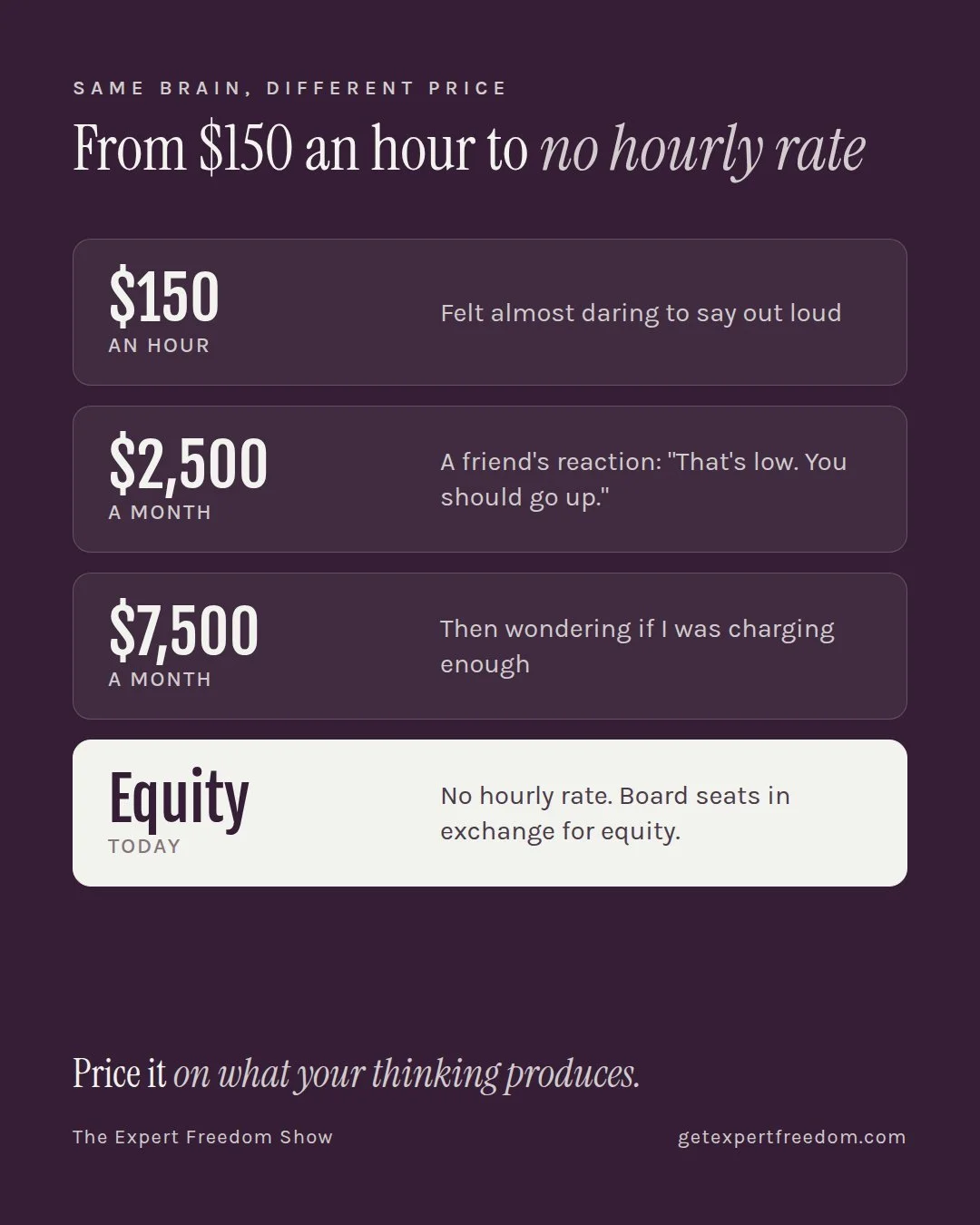
When I first started advising businesses, I charged $150 an hour. I got there the way you probably would: I figured out what it would cost them to hire someone like me full time, divided by 52 weeks, then divided by 40 hours. Saying that rate out loud felt almost daring. If you're working out how to price your services right now, that formula probably sounds familiar, and it keeps a lot of experts stuck.
Today you can't hire me at an hourly rate. There isn't one. I sit on boards in exchange for equity, I hold equity in other companies, and I run a seven-figure business on part-time hours, with three kids and a truly absurd amount of youth baseball.
Here's the interesting part. I knew just as much at $150 an hour as I know now. Same brain, same experience. What changed was what I believed I was selling. Once I understood that people were paying me for my thinking, and I started pricing that way, everything else fell into place.
Want a real starting point for your number? My free pricing calculator takes your background and gives you one, so you're not picking a price out of thin air at 11 p.m.
Why hourly pricing keeps experienced experts stuck
A lot of people think their struggle is sales. Usually the hard part is explaining the price. Many experts don't quite believe someone will pay them for their thinking, so they stumble over the number, or they promise the sun, moon, and stars to justify it.
That makes sense. Most jobs reward you for showing up during set hours and executing, so your brain prices you by time. It's almost subconscious. You were even penalized for working fast, because finishing early just got you more projects.
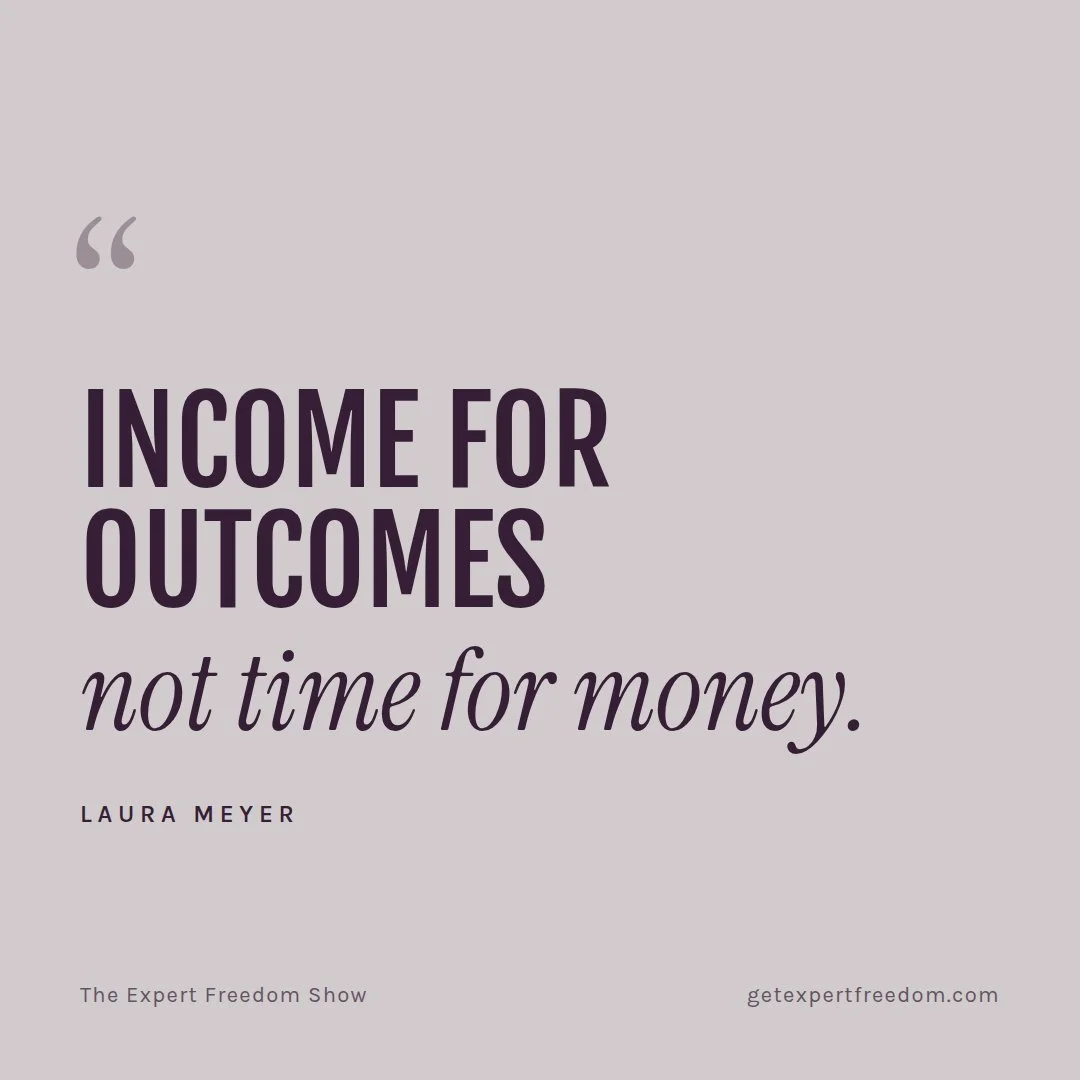
Advising flips that. Companies would rather move quickly, and they'll pay for speed. That's a big part of why they hire an advisor. Clients buy outcomes and judgment.
If pricing has been hard for you, nothing is wrong with you. You've just never had to put a price on your own thinking before, and that's a skill you can learn.
Painkiller offers vs. vitamin offers
Maybe you're thinking, "But Laura, the companies I talk to want someone to come in and get things done." That's usually a sign of a vitamin offer.
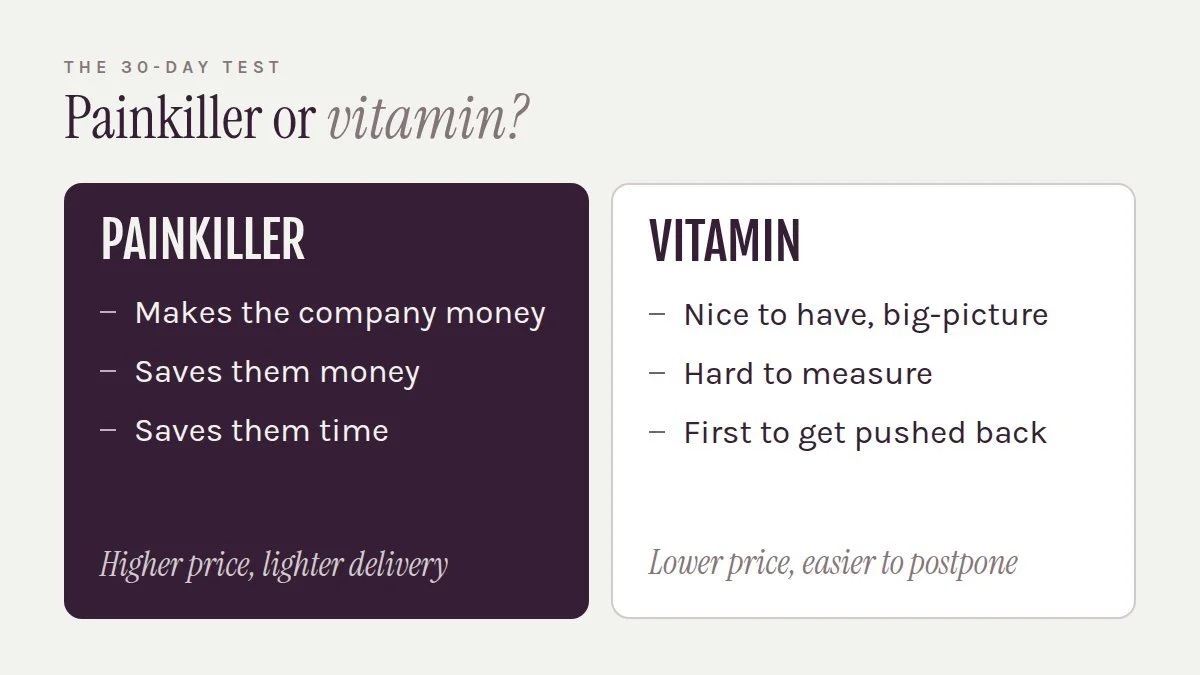
A painkiller offer makes a company more money, saves them money, or saves them time (which, for an organization, is money). If your offer doesn't do one of those things within the first 30 days, it's probably a vitamin.
A vitamin offer is nice to have. It tends to be big-picture, with a longer-term or behavior-based outcome that's harder to measure. Executive coaching is a common example. I love executive coaching, and I've had executive coaches as clients. But when it isn't tied to a measurable outcome, it becomes a luxury, and when fires are burning in a company, luxuries get pushed to next quarter. The company will still get through the quarter without it.
With a painkiller offer, you get paid more, you spend less time in delivery, and it's easier for your client to get a result, because you know exactly where to focus.
Painkillers exist in every specialty: operations, finance, HR, sales, tech. And sometimes a vitamin becomes a painkiller just by adding a metric. Brand strategy on its own is a vitamin. I know, because I've been a branding strategist. Tie it to performance marketing, a new campaign rollout, or a landing page update, and it connects directly to revenue. Now it's a painkiller.
Not sure where your offer lands? Run your background through the free pricing calculator and see what your expertise could be worth.
How to price your services for outcomes
The bigger the painkiller, the more you can charge. This is where you stop pricing your time and start pricing the outcome, and it's when most people realize they've been vastly undercharging.
Think about a company with a lot of moving parts. If you move the needle even 5% or 10% on making money, saving money, or saving time, the impact is big, both while you're working together and for years afterward. That's an ongoing return from your work.
So what should you charge? On the low end, I like our students to start around $2,500 a month. I've seen them charge upwards of $20,000 a month, depending on the client and the projected outcome of the work.
Build a results hypothesis with your client
This is where a lot of people get stuck. "How can I promise them a result?" You can't, and you shouldn't promise anything outside your control. What you can do is build a hypothesis with the client during the sales conversation:
"It sounds like this is happening. If we did X, Y, and Z, this might be possible. Would you agree?"
If they say that feels too aggressive, ask, "If we got half of that, would that give you a reasonable return on the investment?" If the answer is yes, you're on the right track. When you start mapping the math this way, you'll usually find the results you could get a client are far beyond what you were planning to charge.
Why the price matters so much in a high-ticket model
I'm a big fan of the high-ticket, low-volume recurring revenue model, especially when you're starting out. Priced fairly, you only need a few clients to build a six-figure business. Three clients at $5,000 a month is $15,000 a month, with no content mountain and no heavy tech investment. A handful of clients who don't take long to serve gives you the time freedom you've been craving and gets you to your enough number.
Price so you can stay in the advisor seat
Many of the women who join our program have already reached $10,000 or $20,000 months, and they're ready to burn it all down. One more client and they'd have to walk away. That usually happens when you sell yourself as a doer. Before you know it, you have three or four clients, you're working 60 hours a week, and you have three or four bosses. That's the opposite of why you started.
If you're already there, step one is reducing the time you spend in delivery so you have room for business development. If you're just starting, decide how you'll deliver your offer before you land your first client. Framework-based delivery is the unsung hero of this whole model, and most people skip right past it.
And if $2,500 or $3,500 a month feels impossible right now, start lower. That's fine. One woman in our community already had a network of solopreneurs without teams, so she sells smaller packages to them, and she's doing incredibly well. I'd much rather you start lower, see how much value you create, and work up from there than charge a big number and then pack in extra work to feel better about it. That's how people back themselves into a corner.
Think like a premium buyer
I remember telling a friend, a seven-figure business owner, that I was thinking about raising my rate to $2,500 a month. She said, "That's low. You should go up." I had a sick feeling in my stomach, because $2,500 a month felt like so much money to me.
She knew something I know now. To an established, profitable business owner, spending $2,500, $3,500, or even $5,000 a month to make their biggest problem go away is completely worth it. We make investments like that all the time.
A premium buyer isn't counting your hours. She's thinking about how long it would take her to solve the problem herself and what her time is worth. As a business owner, my time is my only non-renewable resource. Handing a problem to someone else so I don't have to deal with it is time and money well spent.
One old-school author I often recommend is Alan Weiss. As I tell the story, Alan would charge a million dollars a year just to be on call for CEOs and board members. No scheduled meetings. Just "call me when you need me." That one call the night before a board meeting was worth it to them. If nothing else, his work will change how you think about pricing.
Visibility makes premium pricing easier
People worry about competitors who charge less. That's why I want you building your visibility as soon as you start getting clients. When you're the best-kept secret around, it's hard to raise your prices.
I'm not talking about TikTok dances or viral trends. I mean real thought leadership within your circles of influence. You don't need millions of people seeing your content. When you develop a reputation, clients come to you, they want to pay you more, and you worry a lot less about what everyone else charges.
Pricing your services for the first time
There's no perfect number, and I can't tell you exactly what to charge. A lot of it is mindset. Stop asking how much time the work will take you, and start asking what it's worth to the client to solve the problem, and what it's costing them every month it stays unsolved.
If you've been employed, every number you've earned was set by someone else: your salary, your bonus, your pay band. When you price your own services, you set the number for the first time. That feels uncomfortable for a week or so, and then it's the most freeing thing you've ever done.
It gets easier. I went from a gasping reaction when my friend suggested $2,500 a month to charging $7,500 a month and wondering whether I was charging enough. Years ago, I thought $150 an hour was daring. The same woman now holds board seats in exchange for equity, using the same brain. She just prices it based on what it produces.
So start with a number that makes you slightly nervous, attach it to an outcome, and let the money come easily. If you want help finding that number, try my free pricing calculator. And when you're ready for the full path, talk to my team and they’ll point you to the right next thing.
Frequently Asked Questions
How do I price my services as an expert?
Price the outcome instead of your time. Ask what solving the problem is worth to your client, and what it costs them every month it stays unsolved. If your work moves the needle even 5% or 10% on making money, saving money, or saving time, the impact is big, so your price can be too.
Should I charge by the hour or a monthly fee?
I recommend a monthly fee tied to outcomes. Hourly pricing keeps experienced experts stuck, because you get penalized for working fast. When I first started advising businesses after starting over at 40, I charged $150 an hour. Today you can't hire me at an hourly rate at all.
How much should I charge per month for my expertise?
On the low end, I like our students to start around $2,500 a month, and I've seen them charge upwards of $20,000 a month, depending on the client and the projected outcome. If $2,500 feels impossible right now, start lower, see how much value you create, and work up from there.
What is a painkiller offer?
A painkiller offer makes a company more money, saves them money, or saves them time, ideally within the first 30 days. A vitamin offer is nice to have and harder to measure, so it gets pushed back when fires start. Painkillers get paid more, take less time to deliver, and make results easier to reach.
How can I price for results if I can't promise them?
Build a hypothesis with your client instead of promising anything outside your control. Say, "If we did X, Y, and Z, this might be possible. Would you agree?" If that feels too aggressive, ask whether getting half of it would still be a reasonable return. If the answer is yes, you're on track.

About Laura Meyer
Laura Meyer is the founder of Expert Freedom and host of The Expert Freedom Show. Over more than 20 years as an entrepreneur, she built and franchised a 12-location company, then started over at 40 and rebuilt to a multi-seven-figure business on part-time hours. Today she advises businesses, sits on company boards, and helps experienced professionals turn their expertise into businesses that fit their lives. She’s a mom of three and a self-described tennis addict.