
If you've been posting to social media, doing all the things, checking off all the boxes, and you're still not getting clients, I can probably tell you why. You're doing the right things. You're just doing them out of order.
The question I get asked more than anything else is how do I get clients. Do I post on social media? Become a LinkedIn influencer? Stand on a street corner with balloons yelling, "I'm available, please hire me"?
None of that. Here's how to get clients without social media: three really simple ways to get started without becoming a content creator, and every one of them uses relationships in the networks you probably already have. Stick around to the end, because there's one tip that makes the selling part almost unnecessary.
If you want the day-by-day structure for turning these relationships into paying clients, grab my free 30 Days to Clients guide. It walks you through exactly who to reach out to and what to say, so you're not guessing.
You're doing the right things, just out of order
So many of you think you need to post everywhere and be everywhere to start getting clients. It's so ingrained that when people come into Expert Freedom, we often tell them, please don't do all of the things you've been doing. Narrow your focus to a few simple strategies. It's such a shift that it takes them a little while to actually hear it.
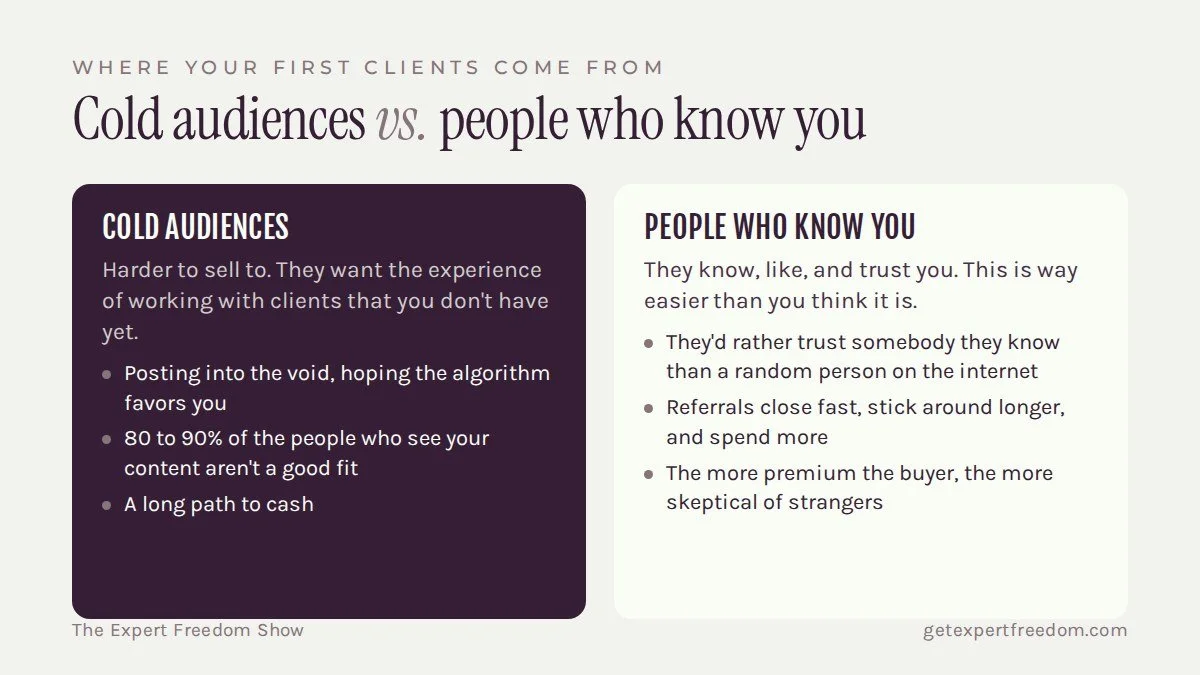
It works because of history. If you have real history with people, and those people know, like, and trust you, this is way easier than you think it is. Posting online into the void and hoping the algorithm favors you that day is just a long path to cash.
Sometimes people look at me and say, "Well, Laura, you have a podcast and a YouTube channel and LinkedIn and Instagram." Yes, I do. I create all of that content, and I think anybody reading this should grow those things eventually. Just not at first. A business survives on cash flow, and if it takes you a long time to see cash, it's really easy to give up. It's hard to stay motivated, and honestly, it's not worth the grind.
The relationship-based strategies below have been working since the beginning of time. Think back to the Mad Men era of business. None of those deals happened because of a Facebook post or the perfect Instagram reel. All of that premium client work happened through handshakes and relationships.
Why we run to strangers instead of the people we know
Before the strategies, I want to talk about why it's sometimes hard to have conversations with the people you know.
A lot of the time, we're afraid of being judged. We're afraid of doing the work and having it not go perfectly. Or we're afraid of sharing our new business with somebody in our network, or with friends and family, and hearing, "Who do you think you are to start running your own business?"
So in our minds, we automatically go to the people we don't know. We think that's safer. We think it's easier to go to cold audiences so we never have to put ourselves in those uncomfortable conversations.
Keep this in mind, though. The people you don't know are harder to sell to. You have the expertise you bring to the table, but you don't have the experience of working directly with clients yet, and that experience is exactly what cold audiences are looking for. And when you're a premium service provider posting to social media, 80 to 90% of the people who see your content aren't even going to be a good fit for your services.
Strategy 1: The Dream 100
The first strategy has some history behind it. It's called the Dream 100, and it comes from Chet Holmes, one of the first salespeople working with Charlie Munger, Warren Buffett's business partner for most of his life. Holmes was struggling. He was putting himself in front of everybody and anybody, and the newspaper company he was helping Charlie grow, where he was in charge of the advertisements, just wasn't growing. Out of frustration, he applied the Pareto Principle to his entire list of leads (roughly 80% of your results come from 20% of your efforts) and narrowed it to the hundred people and organizations who were genuinely the best fit for what he was selling. He became a superstar salesperson, and almost overnight the Dream 100 was born.
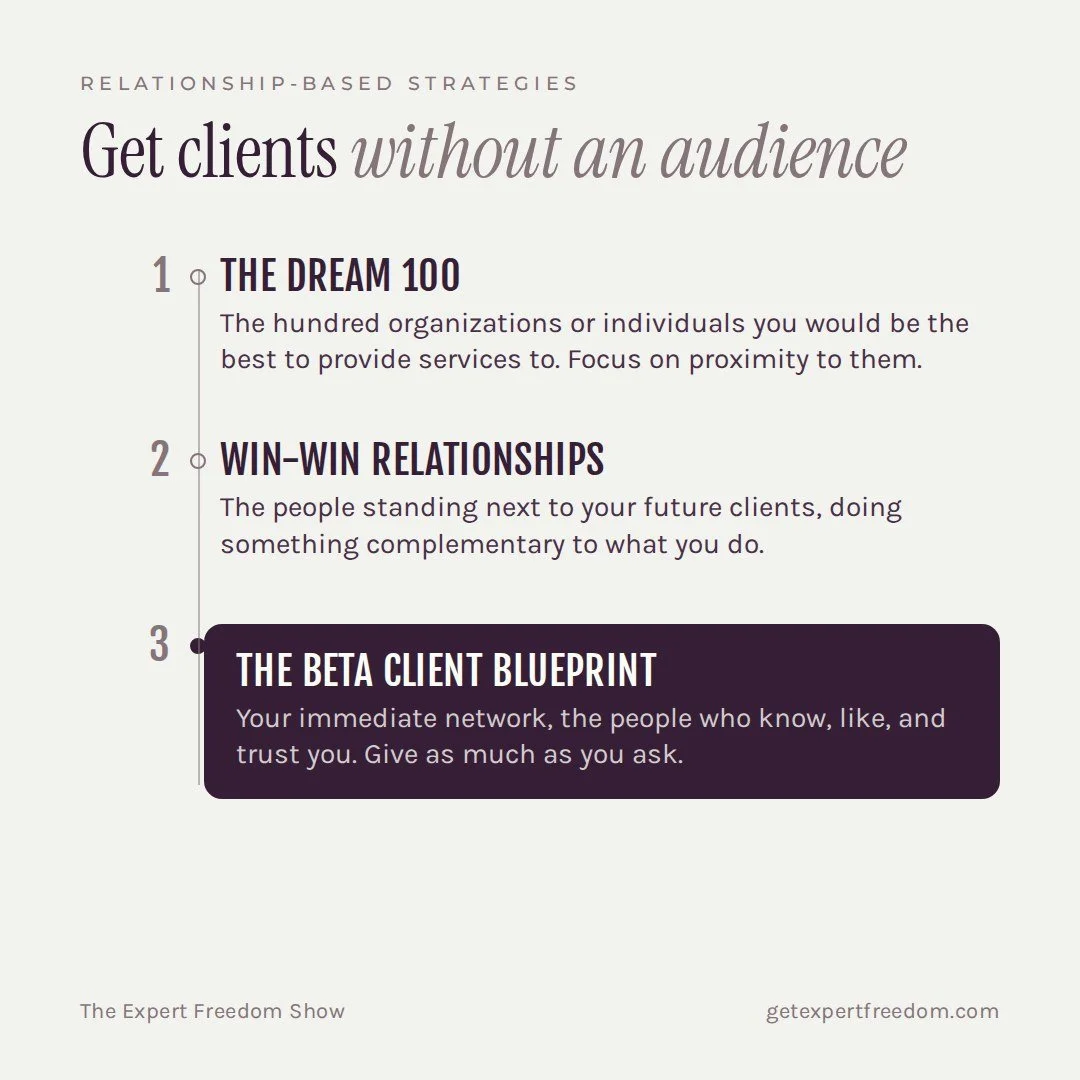
Here's how it applies to you. Once you know what you're going to offer, ask yourself: who are the hundred organizations or individuals I would be the best to provide services to? Then focus on proximity to them.
Talk to any experienced high-ticket B2B salesperson and this is exactly what they do. They're getting in the room with premium decision makers, the kind who sign six-figure and multi-six-figure deals, instead of making reels on Instagram or yapping on TikTok.
One of my students built out her Dream 100 and really thought about it. She wanted to specialize in service-based businesses in her local area: businesses she admired, had heard really good things about, or had been a customer of. Shortly afterward, at a networking event, she ended up talking to the owner of a five-location hair salon, which happened to be on her list. Because she already knew she wanted to get in front of this owner, she could casually mention what she does, knowing it would be a really good fit. She was hired at the networking event on the spot.
Some people would say that was just luck. It was intentional proximity on purpose, because that person was already deliberately on her Dream 100 list.
Proximity to the right hundred people beats visibility, or even virality, to a couple hundred thousand strangers who would never be a fit for your services.
Strategy 2: Win-win relationships
The second strategy is about the people standing next to your future clients, or who might even be your future clients, doing something very complementary to what you do.
Say you're a marketing growth strategist. That's the kind of work I've done as an advisor to big brands and nonprofits. The people you're already talking to may also be talking to your ideal clients. For somebody like me, a fractional CFO, an operations specialist, or a financial advisor could be a really good fit to partner with. Then your job is to make sure you're part of the conversation.
Picture how it plays out. A fractional CFO tells a client their margins would probably improve with better marketing. The client asks, "Do you know anyone?" And the CFO says, "Actually, I do, because one of my other clients used her and got a great result."
Those referrals close so fast. They stick around way longer and spend way more than somebody who found you cold, because they're arriving from somebody who already vouched for you instead of arriving skeptical and defensive.
The mistake I see people make when they're networking is having too short a lens on it. They think, "I need a client this week, and if I don't find one, that event was a waste." You are not hunting for the lead in the room. Over time, you build a small ecosystem of complementary providers who think of you first when the right conversation comes up, and those referrals show up exactly when you need them the most and often when you expect them the least.
I get it, you need clients right now, and strategy three is the right-now part. But think about it from the other side. If somebody you just met showed up trying to sell to you immediately, with dollar signs in their eyes, how would you feel? We just met. It feels yucky. So go for the quick wins, and build for the long term at the same time.
If you want the actual structure for turning relationships like these into paying clients, that's exactly what my free 30 Days to Clients guide walks you through, day by day.
Strategy 3: The Beta Client Blueprint
You might be thinking, "Okay, Laura, this all sounds great, but what can I do right now to get to my first $5,000 or $10,000 a month without building an audience, without becoming a content creator, and without selling my soul to the algorithm?"
That's what we teach inside Expert Freedom, and it's called the Beta Client Blueprint. It's very much an art and a science.
The science: go to your immediate network, the people who know, like, and trust you, and give as much as you ask. A lot of people make offers to their network, don't hear much back, and decide their network isn't working. But in the beginning you don't have proof of concept, case studies, or testimonials yet, so what you're offering needs to be a give along with the ask.
The give is slightly discounted services, not free, in exchange for a case study or testimonial from people in your network. You're looking for case studies.
If you're not sure you even want to have these conversations, think about it this way. There is probably somebody losing sleep right now over the biggest problem in their business, who would much rather trust somebody they know than a random person on the internet. You're keeping all of that to yourself because you don't feel comfortable risking rejection, while they're worried about a finance, operations, HR, tech, marketing, or sales problem that could be solved. That conversation could be the biggest win of their year.
I want to be really clear about one thing. The offer that helps you cash flow to $5,000 or $10,000 a month is not the offer you'll scale with long term. So if you don't want to start having these conversations because you don't know what you really want to do yet, this is how you find out.
You learn the game by getting on the field.
Don't hide that you're new
When you position it as a beta client, a starting-out offer, a case study, the client is much more likely to give you grace and understanding. If you want to sleep on a decision and come back tomorrow with your very best advice, they'll be supportive, because they're one of your first clients and you've already told them that. Hiding the fact that you're new to business puts you in a difficult position and puts your client in a challenging one.
Two things to keep in mind. You are new to business, but you are not new to your expertise or to the experience you bring to the table. Know that, and build on it. And the people you know would much rather work with a trusted resource, somebody they have a history with, than hire somebody they have no experience with. The more premium the buyer, the more skeptical they are going to be of strangers. That gives you a unique and unfair advantage.
I know this from my own experience. If the person I'm working with didn't come from a referral, I typically don't even want to spend my time, because my time is so much more valuable than my money.
I can always create more money, but I cannot create more time.
When leaders, CEOs, and founders are making decisions, they are rarely searching Instagram or LinkedIn for the best person for the role. They're going to the people they know, like, and trust and asking, "Do you know somebody who can help me with this problem?" By reaching out, you could be landing in their inbox at the perfect time, and you don't even know it because you haven't asked.
I know it's hard to get started, but this is the easiest way to begin, because you're getting paid while you get feedback and do your market research. Whether you're in a program like Expert Freedom or doing it on your own, your first set of clients is probably already in your network.
How to get clients without social media: let the offer do the connecting
If you take one thing from this entire post, please let it be this. The best sales skill you'll ever need is an offer so genuinely valuable that just mentioning it to your existing network, to somebody on your Dream 100, or to a potential collaborator is enough. That matters more than a better pitch or a better offer statement.
One of our students was out running errands recently and mentioned what she does to somebody she'd been meaning to reach out to. She was hired on the spot, and she doesn't have some kind of big influence online or a huge following. That's what happens when the offer itself does the connecting.
So this is what changes when you put these three things together. The Dream 100 puts you in proximity to the exact right people instead of everyone and anyone. Win-win relationships mean referrals come in on their own, already trusting you, before you've even talked about your offer. And going to your existing relationships with a give and an ask gets you to a cash flow number you can feel really good about.
None of this requires an audience. It requires a list, a few relationships, a little bit of proximity, and maybe a way to track your relationships and your leads. Everything is intentional.
If you want the day-to-day structure for turning all of this into your first clients, grab my free 30 Days to Clients guide. It's the exact plan, so you're not guessing who to reach out to or what to say.
And when you're ready for the full path, book a call with my team and we'll map out your best next step.
Frequently Asked Questions
How do I get clients without social media?
Use the relationships and networks you already have. I teach three ways: the Dream 100 (proximity to the hundred best-fit people and organizations), win-win relationships with providers who serve your future clients, and beta clients from your immediate network. None of them require an audience, a following, or becoming a content creator.
What is the Dream 100 strategy?
The Dream 100 comes from Chet Holmes, who narrowed his list to the hundred people and organizations that were the best fit for what he was selling. For you, it means naming the hundred organizations or individuals you'd be the best to serve, then focusing on proximity to them instead of everyone and anyone.
Do I need an audience to get my first clients?
No. Business survives on cash flow, and posting into the void is a long path to cash. Grow your podcast, YouTube, or LinkedIn eventually, but start with the people who know, like, and trust you. If you have real history with people, this is way easier than you think it is.
What is a beta client?
A beta client comes from your immediate network and gets a slightly discounted service, not a free one, in exchange for a case study or testimonial. You're giving as much as you're asking, because you don't have proof of concept yet. Position it honestly as a starting-out offer, and clients give you grace.
Why do referrals close faster than cold leads?
Referrals arrive from someone who already vouched for you instead of arriving skeptical and defensive. In my experience they close fast, stick around longer, and spend more. The more premium the buyer, the more skeptical they are of strangers, which gives you an unfair advantage when you come through a trusted relationship.
About Laura Meyer
Laura Meyer is the founder of Expert Freedom and host of The Expert Freedom Show. Over more than 20 years as an entrepreneur, she built and franchised a 12-location company, then started over at 40 and rebuilt to a multi-seven-figure business on part-time hours. Today she advises businesses, sits on company boards, and helps experienced professionals turn their expertise into businesses that fit their lives. She’s a mom of three and a self-described tennis addict.