
About a year before we recorded this episode, Brianna Schaeffer was rocking her newborn in the quiet and the dark, scrolling Instagram and wondering how she was going to make money.
She's now a mom entrepreneur with her own advisory practice. She helps service businesses grow by designing the systems that strengthen their customer experience, so they can do more with the customers they already have. She brings a corporate engineering and operations background, she built her practice while raising two young kids, and she's a student in our Expert Freedom program.
I had her on the Expert Freedom Show because so many people feel like their back is up against a wall. The thing they were doing is no longer calling them. They feel like there's something bigger or something different, and they don't know what it is yet. Brianna's story is what it can look like to take that step anyway.
If you're in your own version of that rocking chair, wondering what comes next, book a call with my team and we'll point you to the right next thing.
From rocking a newborn to building her own business
Brianna's decision was the end of what she calls a several-year realization. It started when her mom watched her son one day a week. Brianna would come home, her mom would tell her how cute something he did was, and Brianna would nod along while realizing she had never seen him do it.
"It was this feeling of like, is this really what it's going to be all about? Should I feel this way forever?" she says.
She quieted that thought for a while. Then, after a very hard personal season a couple of years later, she couldn't quiet it anymore. "I felt really misaligned with my career. And I was like, there's got to be more." Her new mantra became presence and impact.
She got pregnant again, and before she went out on maternity leave, she told her manager she might not come back. She had been there for over a decade. "I thought, maybe this is hormones, so I'm gonna let my hormones settle after I have my kid and see how I feel," she says. The feeling just kept getting stronger.
Then came the rocking chair. "I spent a lot of time rocking my newborns in the quiet and the dark and kind of just scrolling Instagram thinking like, how am I going to make money?" She looked at the options she was seeing online, and she thought about working part time in a role with less mental load. Then my messaging started to resonate with her. She took some of our smaller courses, and then she joined Expert Freedom.
"Definitely the most radical decision I had ever made in my life," she says.
Conversations create cash, even in a slow start
Brianna started her business in November, heading into the holidays, which she calls "the worst time of year." The first handful of months were slow. Her family had built up savings, which gave her some cushion to take the time to figure it out, and she worked diligently through the program, even when it was uncomfortable.
She grew up a competitive figure skater. "Stepping outside of my comfort zone is like in my DNA," she says. "And when you are both excited and nervous, this probably means you're going in the right direction."
About six months in, she had some traction, but she didn't have the clients she needed to make the business financially feasible for her family. So she challenged herself to work on her sales skills. She listened to my Identity Architecture training while running on the treadmill, and she kept believing in one more conversation, because conversations create cash. "Sure enough, right in the month where it was like, okay, we might need to rethink this, I was able to gain two more clients," she says. That fall, when some of her sprints were ending, a referral came in through a community for women in business she had joined.
I love that she brought up figure skating, because I've noticed that so many of our students did sports or other activities growing up. I played tennis growing up and in college, and at least two of my three kids are showing an interest in athletics. Sometimes people ask what it's all for, since they're not going to go pro. It's because it shows up later, in exactly the moments where you need extreme self-belief. It gives you agency.
For Brianna, skating taught resilience. "The basis of the sport is to get critiqued and to fail," she says. It taught her that "growth comes through failure."
Why boundaries get your clients better results
One of the things I've really admired about Brianna, getting to know her inside the program and our accelerator, is how good she is with boundaries. A lot of people still struggle with over-delivering. Brianna gets her clients remarkable results without it, and she works three days a week.
It all goes back to her north star, presence and impact. She admits she over-delivered with her first client. "But I learned my lesson once," she says. Now, when she feels like she wants to do more for a client, she looks at what isn't her zone of genius and brings in someone else who's an expert. "How can I bring more resources around them to help facilitate it?"
She has found that her boundaries give the client an experience that's as good as over-delivering, if not better. "If anything, that was just trying to make myself feel better by over delivering, than actually adding more value to the client."
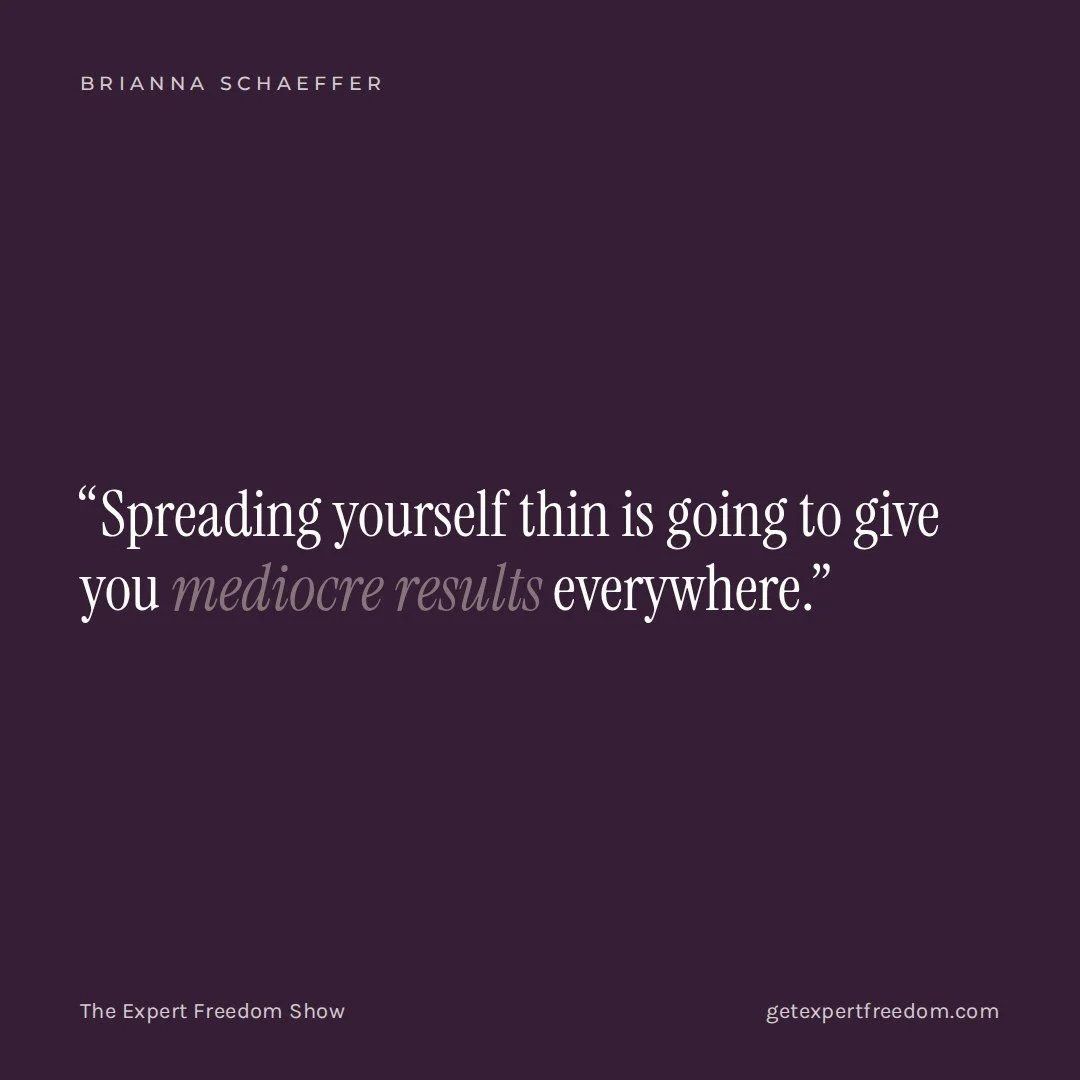
Why does it work? "I think it's just focus," she says. "Spreading yourself thin is going to give you mediocre results everywhere." When she explains her sprints and their one objective, her clients tell her that focus is exactly what they need. Often she's the focus that helps them finish something that has sat on their strategic to-do list for years.
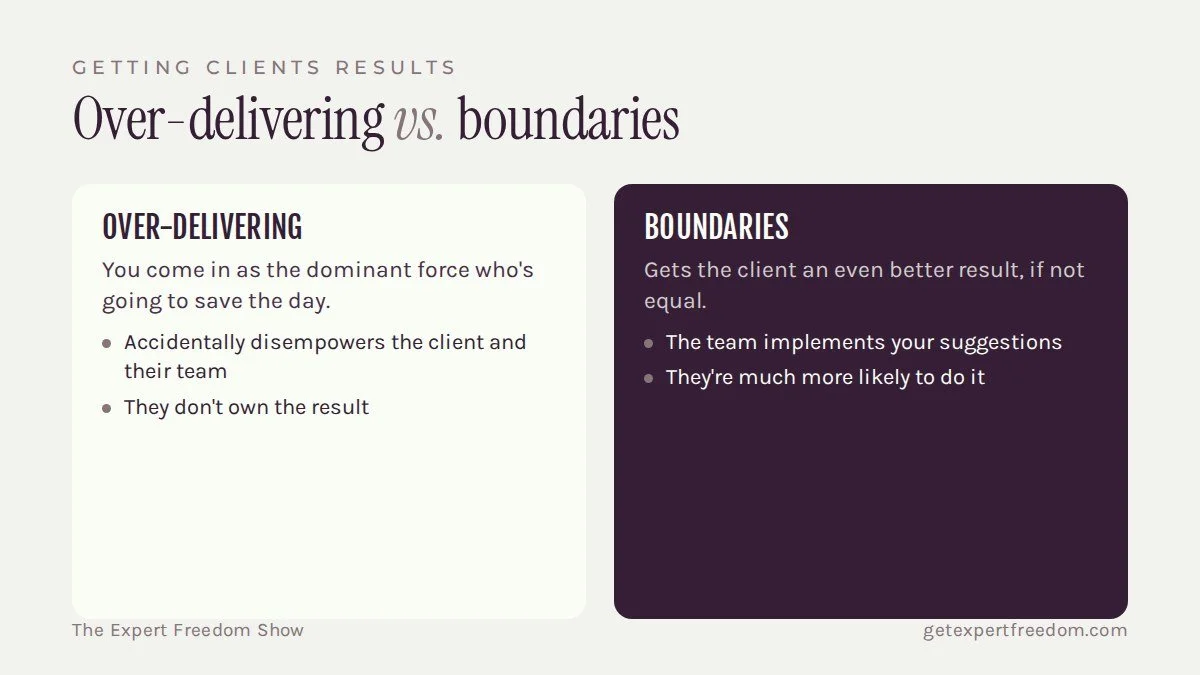
Having been on the other side of this for many years, I can tell you for sure that having those boundaries in place gives clients a better result. When we over-deliver, we sometimes accidentally disempower the client and their team, because we come in as this dominant force who's going to save the day, and they don't own the result. When the team gets to implement your suggestions and recommendations, they're much more likely to do it.
Brianna sees the same thing in her operations work. "If you come in and lay everything out and what you think is the ideal way, uh, they're most likely not going to adopt it into their practice. It's just going to like get filed away," she says. So she brings the whole team in as collaborative partners, even when a client wants the founder to be the only one in the room.
Want to build a business where your boundaries are part of the plan from day one? Talk to my team and we'll help you map out your next step.
A framework keeps you out of over-delivery
In the beginning, Brianna leaned heavily on the LEAP method from the program. Her thinking was that if she couldn't show clients results yet, she needed to show them she had a framework to walk them through the process. So she took LEAP, rebranded it as RISE, and kept the same kind of steps. Even as someone new to her practice, it resonated with clients and helped with their buy-in.
Then she worked through our niche course, where she stopped dancing around the area she wanted to claim: customer experience. "Part of me was like, who am I to say as an engineer that this is going to be my domain of expertise?" she says. She decided to own it, and it gave her much stronger conversations and a much stronger direction in her work with clients.
I'm not an engineer, but my dad is one, and I think I'm raising one, my middle. What I've noticed about engineers is that they're problem solvers. For Brianna, that means breaking problems down further and further until she finds the real root cause. In her corporate role, she was responsible for a lot of machines, and also for building out the early services her company provided for clients. She loved tinkering with the parts of that experience that made clients feel nurtured. Now she owns both the customer experience and the engineering, and she makes that combination her edge instead of a source of imposter syndrome.
Your favorite 10 percent of your old job
Customer experience was a small part of Brianna's previous role, and it was her favorite part. I see this all the time. When people start figuring out what they're going to offer, they often have a little sliver of something they did for a long time, maybe 10 or 15 percent of the job, that was their favorite 10 percent. As we unpack it, they often end up back there. There was a reason they asked Brianna, and not another engineer, to work on those services.
She came into the program with an operations and systems message with a flavor of customer experience. Now she has totally flipped it. Another piece surprised her too. In her old job she was responsible for a lot of proposal generation, and now creative proposals, including how to get proper margins, keep coming up in her work with clients.
People forget about small things like that when they're thinking about their offer. Then they're working with clients, somebody needs a proposal, and they realize they can help with that.
“I now know that in entrepreneurship, you just gotta kind of trust, and it’s going to happen when you probably least expect it.”
What being a mom entrepreneur can look like
Brianna calls this season her inflection point of visibility. Changing her message is what made her feel ready to go out with it. As a self-described people pleaser, deciding on her edge and her opinion took some thought, and pairing engineering with customer experience gave her the confidence.
She mixes in-person networking with social media, and she treats social media as her credibility and authority builder, while connection does most of the work of bringing in clients. She recently exhibited at a fair, and she went to the in-person chapter launch of that community for women in business, down in Providence. "In the corporate world, so much of who I was, uh, my identity was around my career," she says. Now she gets to choose who is around her.
That's what being a mom entrepreneur can look like. A business that runs three days a week, boundaries that serve the client and the family, and a message built on the part of her experience she loved most. She didn't have it all figured out when she started. She had a newborn, a feeling that wouldn't go away, and the willingness to keep having one more conversation.
If Brianna's story sounds like the one you want to write, book a call with my team and we'll map out your best next step.
Frequently Asked Questions
Can you be a mom entrepreneur and still be present with your kids?
Yes. Brianna Schaeffer built her advisory practice while raising two young kids, with presence and impact as her north star. She works three days a week, keeps clear boundaries with clients, and brings in other experts for work outside her zone of genius. Her business is built around her family.
How do I stop over-delivering to clients?
Know your why and build boundaries around it. Brianna over-delivered with her first client and learned her lesson once. Now, when she wants to do more for a client, she brings in another expert for the pieces outside her zone of genius. Boundaries give clients a result that's as good, and often better.
Why do boundaries get clients better results?
Focus. Spreading yourself thin gives you mediocre results everywhere. And when we over-deliver, we can accidentally disempower the client and their team, because they don't own the result. When the team gets to implement your suggestions and recommendations themselves, they're much more likely to actually do it.
What if my expertise was only a small part of my old job?
That's very common. Many people had a sliver of their old role, maybe 10 or 15 percent, that was their favorite part, and as we unpack it they often end up back there. For Brianna, it was customer experience. That small piece became the center of the offer hiding in her experience.
Is it normal for a new business to start slow?
Yes. Brianna started in November, heading into the holidays, and the first handful of months were slow. About six months in, she worked on her sales skills and kept having conversations. Right in the month she thought she might need to rethink things, she gained two more clients. Conversations create cash.
About Laura Meyer
Laura Meyer is the founder of Expert Freedom and host of The Expert Freedom Show. Over more than 20 years as an entrepreneur, she built and franchised a 12-location company, then started over at 40 and rebuilt to a multi-seven-figure business on part-time hours. Today she advises businesses, sits on company boards, and helps experienced professionals turn their expertise into businesses that fit their lives. She’s a mom of three and a self-described tennis addict.